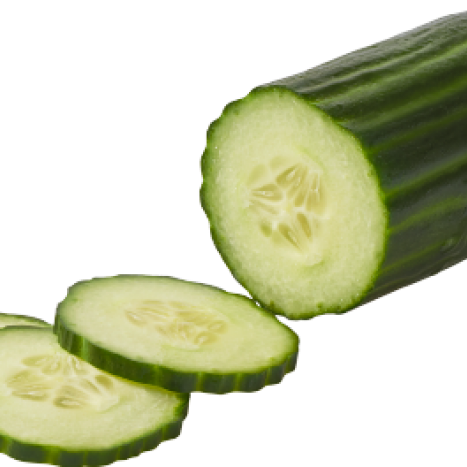


Cucumber
Product Description
Cucumbers (Cucumis sativus) are botanically categorized as berries, which are available in many different sizes shapes and colors. They range from thick, stubby little fruits (10 - 12 cm long) to Dutch greenhouse varieties (of up to 50 cm long). The most popular variety is the long smooth salad cucumber which has a smooth, dark-green skin. It's little brother, the "gherkin" is actually a cucumber that has been harvested when little and pickled in brine. The true gherkin is a different species (Cucumis anguria), which is primarily grown in the West Indies.
Cucumber may not contain a lot of food value, but they make up this lack of nutrients with a wide variety of healthy substances. They were already used in ancient times to dissolve stones caused by uric acid. Their cleansing effect on the intestines, kidneys, lung and skins was also known. People suffering from stomach or liver diseases also benefit from the consumption of cucumbers. They have been known to cure some headaches, bleeding, dizziness, and pale skin. Cucumber juice contains a substance, which promotes blood circulation of the skin. It is for this reason that it is widely used in cosmetics.
Older cookbooks recommend to make cucumbers more digestable by salting them and discarding the water. However, it has since been discovered that the healing properties of the cucumber is contained in its juice. Deficiency diseases, such as scorbut are easily cured by cucumbers, due to its high content of Vitamin C. Eaten as part of the evening meal, cucumbers promote sleep. On hot summer days they make a very refreshing snack and are easily taken along. Besides traces of calcium, copper and magnesium, cucumbers contain substantial amounts of potassium, iron and phosphorous, but also proteins as well as the vitamins A, B1 and C.
History
Apparently cucumbers have originated in the foothills of the Himalayan mountains, just north of the Bay of Bengal, the area which is now primarily occupied by Bangladesh. While there does not seem to be any wild cucumbers present in the area today, scientists have identified a small bitter fruit of the squash family, which is thought to have brought forth the cucumber. Recent investigations led to the assumption that cucumbers may have started off on the African continent, however fossils, which could substantiate such claims have not yet been found. Fact is that cucumbers have already been widely cultivated in the past, which is evident from written records in many different cultures. Records show that cucumbers were already grown as far East as China as early as 2,000 years before the Christian Era. Their introduction to the West in Asia Minor, North Africa, Greece, Italy, etc. seems to have gone along with the dessimination of the Christian belief. The Romans had already developed fairly sophisticated methods of growing cucumbers, as it is reported that the Emperor Tiberius consumed these deliciously juicy fruits every single day in the year. Cucumbers were grown in the gardens of Charlemagne in the 9th century. From there it took a while before cucumbers made it to England. However, they had to be introduced twice: in the 14th century and again in the 16th century, as the early attempts to cultivate them failed due to war and unrest at the time of the first introduction.
Columbus was responsible for bringing cucumbers to the New World, where they were first planted in 1494 on Haiti and possibly on other islands. From there they spread throughout the North American continent, as the natives enjoyed them as much as their local squash.